Challenge
Getting Your Young Kid Outside — Seven Things You Can Repeat
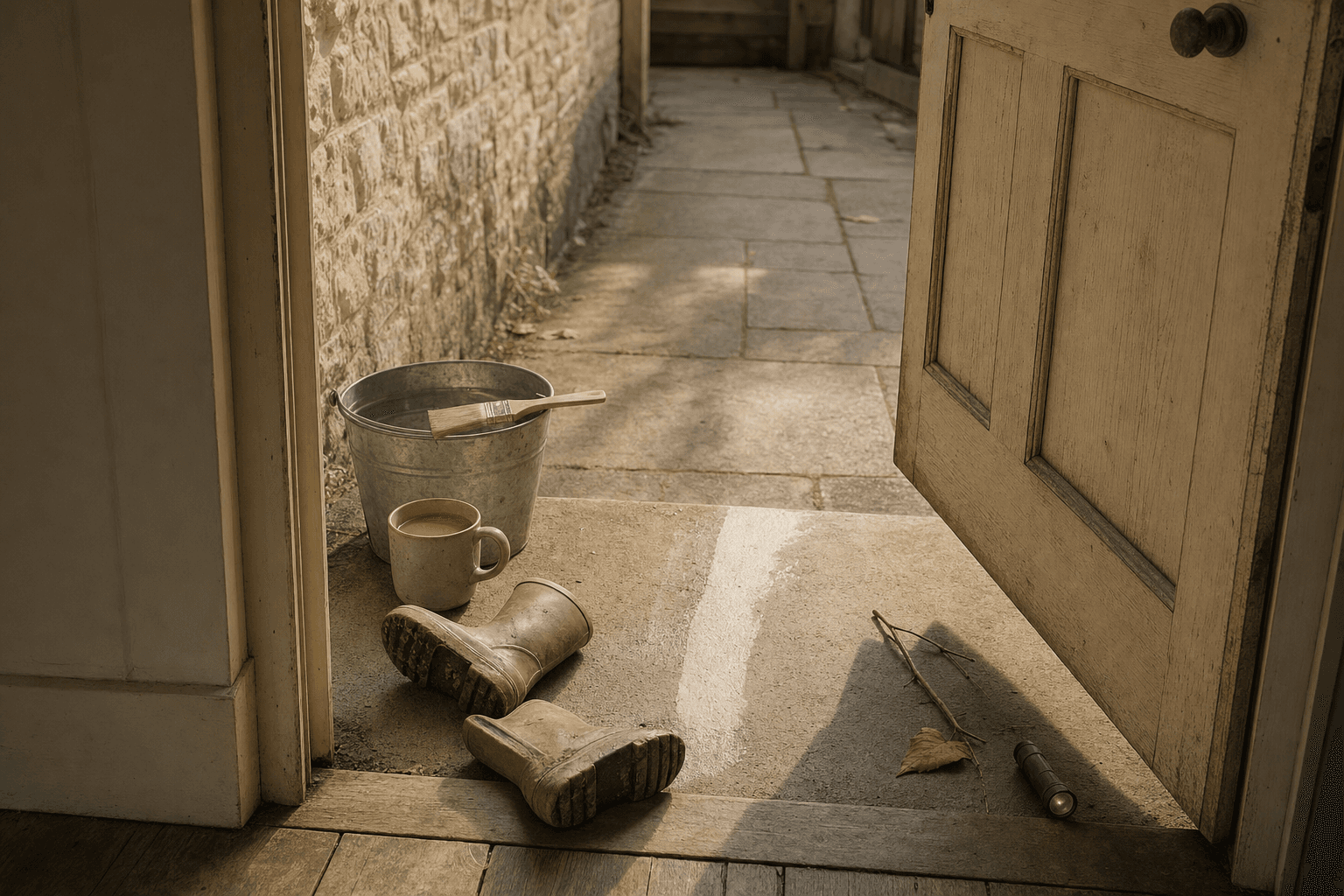
Seven small things that get a young kid — roughly three to nine — outside without it turning into a project. No garden needed: a balcony, a front step, a shared courtyard or the street outside all work. You don't have to entertain anyone. Any order, your pace.
You are not the entertainment. Being out there with a cup of tea, saying nothing, is the whole job.
Go out with them and do nothing
Minimum that counts: Use a slot that already exists — after dinner, before the bath, the gap before you cook — and open the door. Go out with them, take whatever you were drinking with you, and sit down. Ten minutes. Don't suggest an activity. Outside there is more lying around to pick up and less that matters if it gets broken, so most kids find something within a couple of minutes; you only have to be there. No garden? A balcony, a front step, a shared courtyard, or to the end of the street and back all count. Ten minutes gets you out of the house and no further — some evenings they poke at a drain and come straight back in, and that is the whole of it.
Full version (if you have capacity): Use the same slot three days in a row. Three days won't make it automatic — nothing works that fast. What it does is hang the ten minutes off something you already do, so you stop deciding it from scratch each evening: a thing attached to dinner comes back after a bad week, and a thing you have to remember usually doesn't.
Name three things to go and find
Minimum that counts: Say three things out loud and let them go: something red, something that was alive, something smaller than their thumbnail. That's it — no list, no prize. For a three-year-old, make it two things and make them easy. For an eight-year-old, make one of them nearly impossible. This one works on bare pavement as well as it works in a garden. It gets you through the first five minutes — the bit where they'd otherwise be at your leg asking what to do . Then it's over; three things found doesn't turn into an afternoon.
Full version (if you have capacity): Write ten on the back of an envelope and leave it by the door. A list too long to finish in one go is a reason to go out again tomorrow that you didn't have to think up — and when it's done, let them write the next list for you — the one version you don't have to run at all.
Hand them water and something to paint with
Minimum that counts: A bucket half-full of water and an old brush, a sponge or a rag. The wall, the fence, the ground, the step — it all dries and goes back to blank, which is exactly why it can be done again tomorrow. Stay where you can see them; even a bucket is worth watching with a little one. Ten minutes of them not needing you is about what this gives you, and there is nothing at the end of it — nothing made means nothing to keep, admire or find a shelf for.
Full version (if you have capacity): Add dirt. An old pan, a wooden spoon, a jug of water and a patch of soil or a plant pot is a whole kitchen as far as a five-year-old is concerned. Say out loud that the clothes are going to get filthy before you start, and it stops being an argument. Mud does more than water does: it holds a shape, so it turns into cooking and building instead of marks that vanish, and it keeps them there long after plain water has dried. You will be washing the clothes.
Pick one thing and watch it together
Minimum that counts: Choose one small thing and watch it for two minutes — ants going in and out of a crack, a snail, a bird on a wire, a plane coming over. Then say one thing you notice, out loud, and leave a gap: “it keeps going back to the same bit of wall.” Watching side by side in silence does little on its own — it's the swapping of noticings that makes a kid look harder, and most will answer one with one of their own. You don't have to teach anything or know what it's called. Two minutes won't make them a noticer — it makes them look once, properly.
Full version (if you have capacity): Go back to the same spot a few days later and ask what's different. One look is a look; the same thing twice, a few days apart, is where noticing starts, because there is now something to compare it with. A kid who can tell you what changed has started doing it without you, and that's the part you can't do for them.
Give one instruction, then leave it alone
Minimum that counts: One instruction and nothing after it: “make it as tall as you can.” Sticks, stones, leaves, bricks, the cushions off a chair. Then stop talking. If it topples, it topples — the rebuild is the part they like. One rule and a pile of junk is enough to get a build going. What it won't survive is you improving it — and it won't be there tomorrow either, so this is a single go.
Full version (if you have capacity): A den. A blanket over two chairs, a washing line, a railing, the corner of a balcony. If you can leave it up overnight, leave it — something still standing in the morning is somewhere to go back to, so they start again without you starting it. That's the difference between one go and a thing they return to on their own.
One torch each, five minutes outside
Minimum that counts: When it's dark before dinner, this is the easiest one on the list. A torch each (a phone torch counts), five minutes outside, hands or cut paper throwing shadows on a wall. All it does is make a step or a balcony you've both seen a thousand times into somewhere else — somewhere new without going anywhere. Go out with them, and keep it to your own garden, step or street — nowhere near traffic. It's strongest the first few times; once the dark is ordinary again, a torch is just a torch.
Full version (if you have capacity): A short walk to the end of the road and back, torches on. Switch them off for ten seconds and just listen, then each name one thing you heard. The listening gives them something to do out there rather than something to look at, so it still works on the tenth evening, when the dark alone has stopped being strange.
Go out in the rain for five minutes
Minimum that counts: Next time it rains, go out for five minutes and jump in one puddle. Whatever coat exists, or no coat at all if the rain is warm. Put a towel by the door before you open it. Then the wet clothes are just wet clothes, and nobody has to have a row about them. Five minutes and one puddle won't fill an afternoon. What it settles is bigger: rain stops being the reason you stay in.
Full version (if you have capacity): Race something down a gutter, a drain or a slope — a leaf each, a stick, a bottle top. Moving water does the holding for you: it keeps changing, so there is always a next go, and a six-year-old will stay with it long after they'd have finished with a puddle. You can't put this one in the week ahead: it's there when it rains and not otherwise.
At the end
If one of the seven turns into the thing you just do — the door open after dinner, a torch on a dark evening — then it's working. The other six are there for when that one wears thin. And weeks will go by where nobody goes out at all: a wet week, a hard stretch at work, a kid who wants nothing to do with any of it. When it comes round again, you just open the door. Nothing is lost, there's nothing to keep up, and you're not behind.