Challenge
Helping Your Kid Practice Without Nagging — Eight Things You Can Do
Eight small ways to keep a young kid — roughly four to ten — practicing something they chose: music, swimming, a sport, the times tables. Short, kind sessions, led by them, with you alongside. It won't make them good at it; a teacher does that. It keeps them willing. Any order, your pace.
You decide when it happens. Let them decide what happens in it — that's the part that keeps it theirs.
Say how long it is before they start
Minimum that counts: Say the length out loud before they begin, and make it shorter than feels right — five minutes at four or five, ten at the outside by nine or ten. Then end it on time even when it's going well. Especially when it's going well. The thing that has to survive the evening isn't the piece or the pedalling, it's their willingness to start again tomorrow, and a long session is what spends it. Five minutes won't get you far: one line of the tune, four or five goes at the corner. That's the trade — less covered tonight, in exchange for a kid who doesn't dread it.
Full version (if you have capacity): Put the same five minutes on three or four days instead of one long go on a Saturday. Pick the days with them, and don't add more once they're picked. The same total time, spread out, holds better than it does in one sitting — the small forgetting in between is where the remembering gets built. The spreading out is what makes it stick. The five-minute cap is what keeps them willing. Two different jobs, and you need both.
Attach the five minutes to a fixed point
Minimum that counts: Pick a moment that already happens every day — after dinner, before the bath, when you both get in — and let that be when it happens, instead of a time on the clock or a reminder on your phone. Say it once: “we do it after dinner.” Something hung off a thing you already do comes back on its own. Something you have to remember needs somebody to do the remembering, and that somebody ends up being you, out loud, which is the whole thing you're trying to avoid. What it fixes is the deciding — it stops being a question every evening. What it won't survive is a day the routine itself breaks: a late dinner, one of you out. That's not the plan failing.
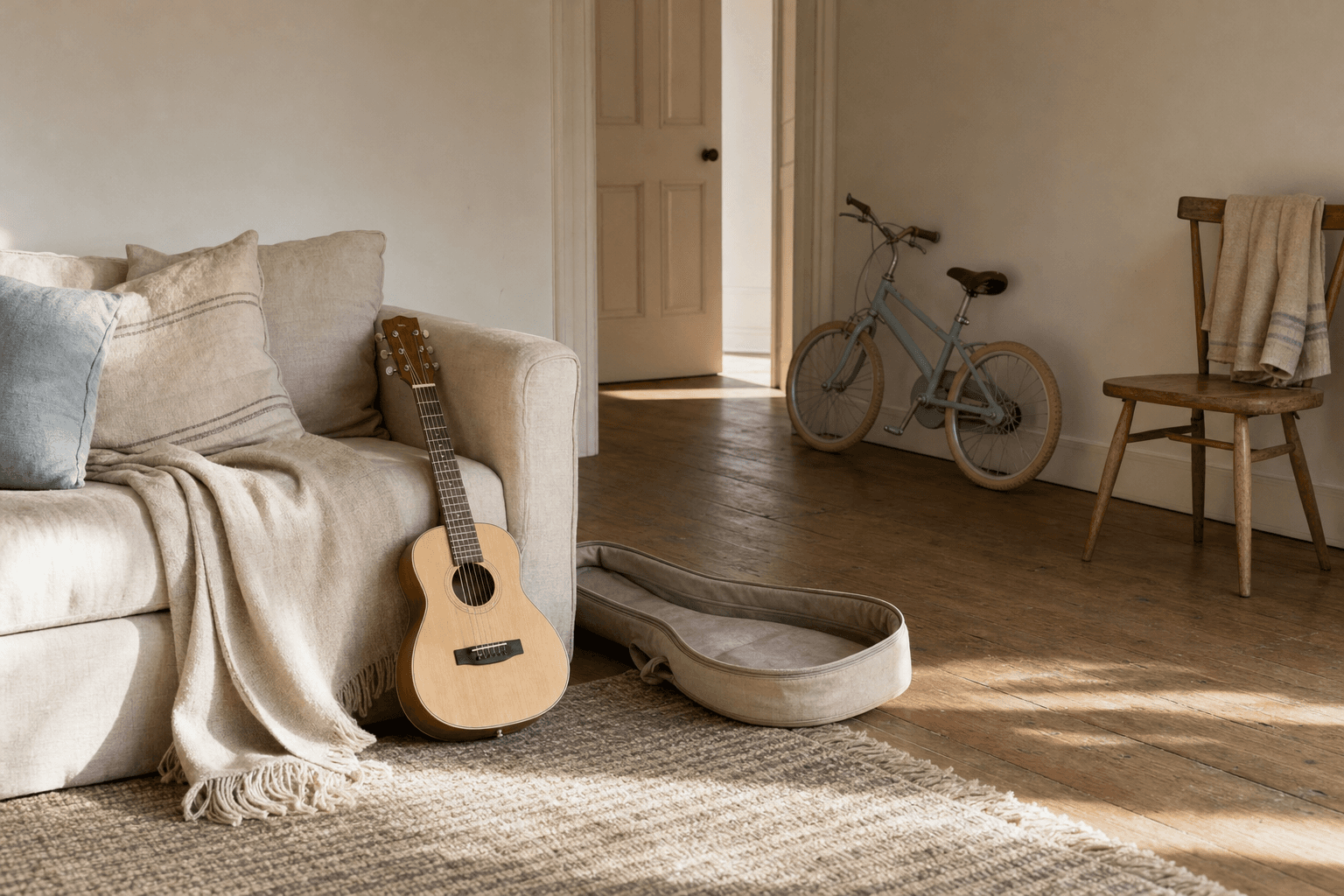
Full version (if you have capacity): Keep the thing where the moment is. Guitar out of its case and leaning in the corner by the sofa. Bike unlocked by the door. Cards left on the kitchen table. A thing you have to go and get is a decision; a thing already standing there isn't. Plenty of skipped evenings are lost in the fetching rather than the doing. It also means they can start without you, which is the only way it stops being yours.
Ask what they want to work on
Minimum that counts: Ask one question before you start — “what do you want to do today?” — and take the answer, including when the answer is the easy bit they can already do. A kid with a say in it stays with it. A kid being run through someone else's list is counting the minutes, and eventually they'll tell you so by refusing. What you get is five minutes that happen willingly. What you don't get is the hard bit — they will pick what they're good at, almost every time. That's the teacher's half of the job, and it isn't yours to rescue.
Full version (if you have capacity): When something hard does have to happen — the piece their teacher asked for, the hill, the sevens — let them choose the shape around it. Hard thing first, then two minutes of whatever they like, and say so before you start so they can see where it ends. Same content either way. The difference is a kid who agreed to the deal rather than one who was put through it, and a kid who agreed is a kid who'll agree again tomorrow.
Take part instead of supervising
Minimum that counts: Do your own version alongside them. Clap the rhythm. Say the sevens back and get one wrong. Take the other end of the catch. Walk beside the bike instead of standing at the end of the path. The moment you're an audience you're also a judge, and a seven-year-old can feel the difference from across a room. What this gets you is five minutes where nobody is being marked, which is most of why it keeps happening. What it won't do is let you fix their hand position, and you shouldn't try. A parent correcting technique usually gets the opposite of what they were after. That's what a teacher is for, and if there isn't one yet, the hard bit waits.
Full version (if you have capacity): Be the one who's bad at it. Hand them the instrument and ask them to show you. Let them test you on the times tables. Ask what the gear lever actually does. Being made to explain it is the point — a kid who has to put it into words finds out what they do and don't know, which another go round the same thing doesn't show them. It's also the only five minutes in the week where they're the one who knows and you're the one learning.
Name one thing they did, then stop talking
Minimum that counts: Say one concrete thing they did, then stop. “You got all the way to the end that time.” “You didn't put your foot down until the corner.” No verdict on them — not “you're a natural”, not “you'd be good at this if you practiced”. Describe what happened and leave it there. A kid praised for being clever at something has something to lose the next time they try it; a kid told what they did has something to do. What this prevents is a bad five minutes becoming a bad evening. What it won't do is stop the tears, or the shoe being thrown. Those are allowed.
Full version (if you have capacity): End it right there — mid-mess, mid-tears — say the practice is finished for today, and then say nothing else about it. Not at bedtime either. Stopping early leaves you with a bad five minutes instead of a bad hour, and it tells them the practice never runs on past the point where it hurts. Yes, they'll work out that falling apart ends it. For a kid this age, practicing something they chose, that's the right trade — a kid who knows it will stop is a kid who will start.
Give the skill one job that isn't practice
Minimum that counts: Once, give the thing a use that isn't practicing. Ride to where you were going anyway instead of doing laps. Play the one tune they can play down the phone to the aunt who asked. Hand them the money at the till and let them work out the change. Practice with no visible point is a chore by definition, and one afternoon where the skill does something real is a better answer to “why do I have to?” than anything you can say out loud. What you get is one evening where it means something. What it won't do is change tomorrow's five minutes.
Full version (if you have capacity): Make it a standing thing with one person — the same grandparent, the same uncle, roughly weekly, down the phone or at the kitchen table. Someone who asks after it by name and remembers what they played last time. That's an audience who is on their side, which is the opposite of a recital: nothing is being marked and nothing has a date. A kid with one person asking tends to stay with it after the novelty has gone. If they don't want to play tonight, the person waits. The moment it has a deadline it has become a performance, and you've lost the thing you were building.
Take the no without charging them for it
Minimum that counts: When they say no, say “all right” and let the evening go. No deal-making, no moving it to the morning, no owing it back tomorrow, and no mention of it at breakfast. A refusal you argue with turns the thing into a fight, and it's a fight they can win permanently by never picking it up again. If saying no is easy, the thing stays theirs. What this won't tell you is whether it's a bad week or the end of the guitar. You won't know that for a while, and pushing won't tell you sooner.
Full version (if you have capacity): Offer the smallest possible version once, then drop it: “one go and we're done.” One go is often all the resistance actually was, and a kid who does one go hasn't put it down. If the answer is still no, that's the answer — asking a second time is nagging, and this is the one ask you get. What the small offer rescues is the evenings that were only ever about starting, which is most of them.
Restart smaller than where you stopped
Minimum that counts: After a gap — two weeks, two months — start back at less than you were doing, not where you left off. One minute. The easy piece. The flat bit of path with you holding the saddle. And say nothing about the gap: no “finally”, no “it's been ages”, no counting the weeks. Going straight back to the old level is what kills a restart: the first go is worse than they remember, and they decide they've lost it. What the small restart does is get the thing picked up at all. What it doesn't do is recover the ground — they will have gone backwards, and that's just true. It reopens the door; it doesn't undo the gap.
Full version (if you have capacity): Leave it out, in reach, where it used to live, and leave it there without saying anything. Something in the corner gets picked up; something in a case under a bed doesn't. If two weeks pass and nobody touches it, do the one minute yourself where they can see you, and ask if they want a go. A restart they started is the kind that holds — and they can only start it if it's within reach, which is the part you can arrange.
At the end
If one of the eight turns into the thing you just do — the five minutes after dinner, the bit where they pick — then it's working, and you can leave the other seven alone. Weeks will go by with nothing: a hard stretch at work, a week away, a kid who is done with it for now. That isn't a debt and there's nothing to make up. You start again smaller than you stopped. And if they do put it down for good, the time was spent sitting next to them, which was never really about the instrument, or the bike.