Challenge
Making Something With Your Young Kid — Seven Things You Can Repeat
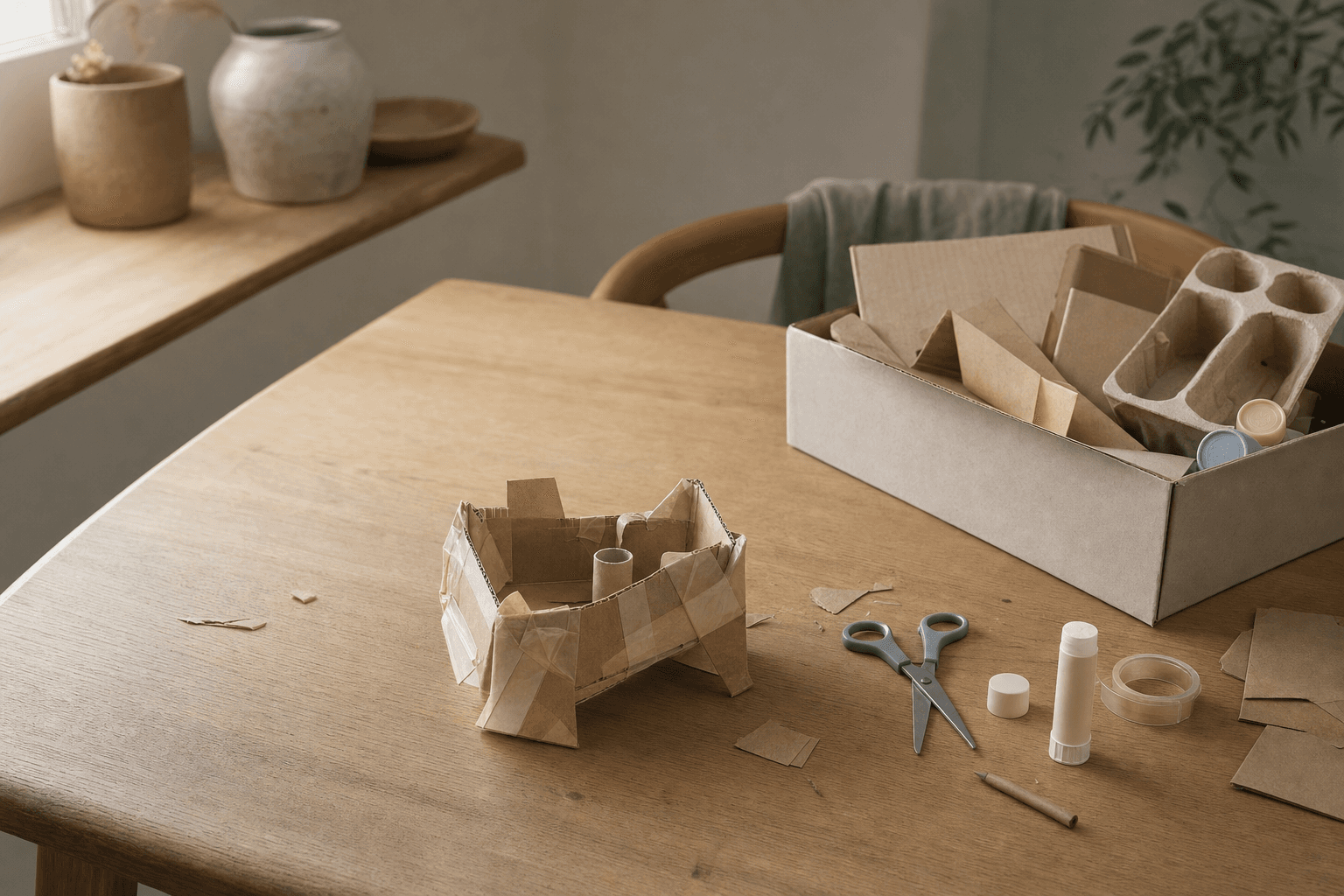
Seven things that get you and a young kid — roughly three to nine — making something together most weeks. A small, shared creative half-hour, on a weeknight or a weekend morning, that the two of you come to expect. Nothing to buy: the recycling is the materials, and they decide what you’re making.
They’re in charge of what gets made. You’re there to hand them things and not fix anything.
Start the box with today’s recycling
Minimum that counts: Find a box, a bag or a spare drawer, put it somewhere you can reach without moving anything else, and tip in what you’d have thrown out today — a cereal box, the lids, the corner of a cardboard parcel, old envelopes, a bottle top. That’s the whole job for today. What it buys you is the two-minute start: next time nobody has to find anything or decide anything, which is the bit that usually kills this. What it doesn’t buy you is anything made — today you filled a box, and that is all.
Full version (if you have capacity): Keep the scissors, the tape and a pen in the same box so there’s no hunt halfway through, and let them put things in it during the week — the cardboard tube from the paper towels, the tray the tomatoes came in. A box they’ve stocked themselves is one they’ll open without you. That’s the difference between you starting this every single time and them starting it sometimes.
Ask what you’re making, then do what they say
Minimum that counts: Ask “what are we making?” and then do what they say for ten minutes. If the answer is a house for a snail, you make a house for a snail. If they tell you your bit is wrong, you change it. This is the part that does the work, not the making. A young child spends most of the day being directed, and being the one giving the instructions while an adult goes along with it is rare enough that they notice. Ten minutes of it won’t change anything about them. It gives them one thing in the day that went the way they said.
Full version (if you have capacity): Say it out loud before you start — “you’re in charge of this one, tell me what to do” — and ask them what your job is. Naming it takes away the thing they’re otherwise watching for, which is the moment you quietly take over. When they stop watching for that, they ask for bigger and odder things, and the half-hour goes further than it would have.
Make a bad one next to them
Minimum that counts: Make your own alongside theirs, badly, and leave it badly made. Don’t rub it out, don’t start again, don’t apologise for it. Say one flat sentence about what went wrong — “the legs came out different lengths” — and carry on. Being visibly bad at something in front of a child is useful, not a consolation prize: it’s the clearest way to show that a wonky result is a normal result and not a reason to stop. Make a good one and that’s what theirs gets measured against. A badly made one teaches them nothing at all — what it does is leave nothing for theirs to be measured against.
Full version (if you have capacity): Let them be the one who’s better at it. Ask them to show you how they did theirs, then do yours again their way. A child correcting an adult who actually takes the correction is unusual in their day, and it’s the surest way they’ll believe you aren’t scoring them.
Use a slot you already have
Minimum that counts: Don’t find new time — take a slot that already exists and use that one. After dinner, with the plates still out. The gap between bath and bed. A weekend morning before anybody is properly dressed. Get the box out, put it on the table, sit down. Half an hour is the most this ever needs to be; ten minutes counts. A half-hour you have to carve out is a half-hour you’ll cancel, and one that’s already there just gets used. What it won’t do is make time appear in a week that is already full — on those weeks this doesn’t happen, and nothing is lost.
Full version (if you have capacity): Use the same slot twice, a few days apart, until it has a name — the after-dinner one, the Sunday morning one. Once it has a name they’ll ask for it, and then remembering it stops being your job.
Pick the surface and the five minutes
Minimum that counts: There is going to be a mess — cardboard scraps, tape stuck to the table, bits on the floor. Decide two things first and it stays small. One: where it happens — the kitchen table, a tray, the floor with an old towel under it — said out loud, and it has to stay there. Two: the five minutes at the end when everything goes back in the box and you wipe the table. Do that bit yourself, or do it together, but don’t make it the price of the making — a child who learns that making things ends in a job they didn’t want will stop asking to make things. Five minutes is the honest number. It isn’t nothing, and it isn’t more than that either.
Full version (if you have capacity): Let them choose where it happens, inside the limits you’ve set — the table or the floor, this room or that one. Most of the friction in this is the argument about where; handing them the choice ends it before it starts, and they’re far more likely to keep it in the spot they picked themselves.
Ask them what should happen to it
Minimum that counts: When it’s done, ask them what should happen to it — and let “throw it out” be a real answer, which it often is. Take a photo if you want one, then let the thing go. This matters more than it sounds. If everything gets kept, the making quietly turns into producing something, and a child who thinks the result has to be good enough to keep will stop starting things in front of you. It’s also the reason parents say no to this in the first place: the house fills up. What you give up is the keepsake, and you were never going to find a shelf for all of it anyway.
Full version (if you have capacity): Keep one windowsill, one shelf or one spot on top of a cupboard for whatever is current, and when something new arrives, something goes. Let them pick which one goes. Choosing what to let go of is a different thing from being told the fridge is full, and it keeps the making clear of the question of whether it was any good.
Ask one real question, then one more
Minimum that counts: Ask one question about their thing that you genuinely don’t know the answer to — “what’s that bit for?”, “who lives in there?” — then wait, and ask one more about whatever they said. Describe what you see rather than rating it: “you’ve used every lid in the box” does more than “that’s amazing”. The making is mostly an excuse to sit next to each other with something in your hands, and the back-and-forth over it is the part worth having. Two questions won’t make a conversation. What they do is turn two people making things in silence into something shared.
Full version (if you have capacity): Tell them about yours as well, and take their suggestions for it. A question going both ways makes it two people doing the same thing rather than you interviewing them about theirs — and that’s usually when they start telling you things that have nothing to do with the cardboard.
At the end
You’ll know it’s working when they’re the one getting the box out. That’s the whole of it — not a better drawing, not a tidier table, just a kid who assumes this is something the two of you do, most weeks. Some weeks none of it will happen: a hard stretch at work, somebody ill, a child who wants nothing to do with you and a piece of cardboard. Nothing is lost when that happens. The box stays where it is, you haven’t fallen behind, and there’s nothing to make up for.