DIY Idea
An Altered Dictionary — Twenty Entries for a Milestone Birthday
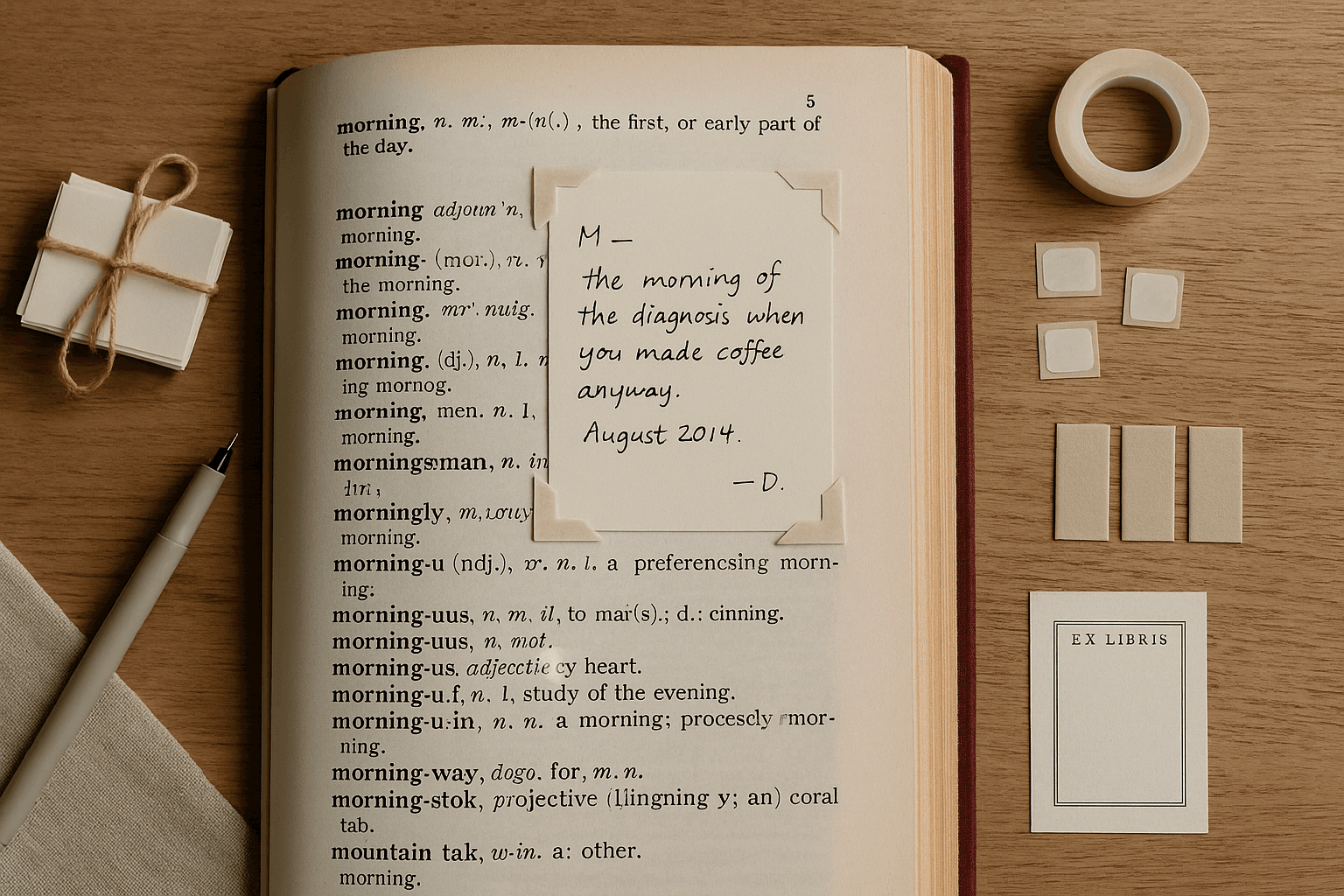
A real hardcover dictionary, overwritten with twenty entries from your life with them — each one a specific moment, a year, a name. For a 50th, a retirement, a long-marriage anniversary. An evening to find the dictionary, two evenings to write, an afternoon to mount.
Materials
- A used hardcover dictionary — Webster's or Oxford, 1960s–2000s, well-bound, sourced from a second-hand bookshop (an older, worn copy looks the part)
- Thirty pre-cut archival slips, 2 × 3 in (twenty for your entries, ten spare for theirs), acid-free cream or ivory (NOT white — reads as a printout)
- A fine-tip archival pen, 0.3–0.5 mm, black (gel or technical, with archival ink so it doesn't fade)
- Removable archival glue dots, one per slip, plus one small envelope that fits the 2 × 3 in slips, for the inside back cover
- Ten small adhesive tabs in one neutral color — for marking the entries you most want them to find first
- A printed bookplate for the inside cover — name, year, your signature in hand
The dictionary already has the words. Your job is to overwrite them with the years.
Instructions
- 01
Source the dictionary first. A used Webster's or Oxford from a second-hand bookshop — never a brand-new one. An older, worn copy looks the part. Look for sturdy binding (it will be opened many times) and intact A–Z. Spend an evening picking it; this part is half the gift.
- 02
Draft thirty entries on paper. Cut to twenty. Sit with a notebook. For each letter you want to use, write the moment that letter holds — not the adjective. M is for the morning of the diagnosis when you made coffee anyway. T is for the taco truck on 18th Street, every Friday in 2019. Cut the abstract ones. The cuts are part of the work.
- 03
Edit twice — strip every praise word. The second pass kills amazing, incredible, the best of, always. What's left should be only facts: what happened, when, what they did. The praise is what the reader supplies for themselves when they read what happened.
- 04
Hand-write each entry on its slip. One moment per slip. Date it (— August 2014). Sign it small at the bottom (— D.). Do not print. The handwriting is what separates this from a corporate yearbook.
- 05
Mount each slip beside its real entry — never glued over it. Put one removable glue dot on the inner edge of the slip and press it into the outer margin next to the entry, so the slip lies on the page like a flap. Lift it and the original entry is fully readable; nothing is stuck to the printed text. Tab the ten you most want them to find first.
- 06
Write the bookplate. Hand it over in person. Inside the front cover: Made for [name], on the occasion of their [50th / retirement / 40th anniversary]. From [you], [year]. Wrap in brown paper and twine — not gift wrap. Hand it over; do not mail. Watch them open to A.
What to write inside
For [name] —
[Twenty] entries out of however many we've collected. Each one is a real moment, with a date when I had it. Read it slowly. The tabs mark the ones I most wanted you to find; the spare slips in the envelope at the back are for the ones I missed.
— [your name]
Sign however you would — With love, Always, or just your name.
Pro Tips
- Best for a big milestone. A 50th birthday, a retirement, a 25th wedding anniversary: the more years you share, the easier twenty moments come. If you have fewer, use fewer, and change the number on the card.
- One entry per letter is the easiest rule. Skip the letters that don't carry a moment (X, Q, Z often). Twenty entries across A–Y reads as deliberate; thirty entries with three under L reads as a flex.
- Glue the small envelope inside the back cover, mark it Yours, and put the ten spare slips in it. They can add their own entries beside the real words, the same way. The first time you see one of theirs alongside yours, the gift will have done its work.
- Don't decorate the slips. No washi tape, no stickers, no calligraphy flourish. The format is plain — handwritten, signed, dated. Decoration competes with the words and ages badly.