DIY Idea
A Good Day / Hard Day Box — For Someone Living with Illness
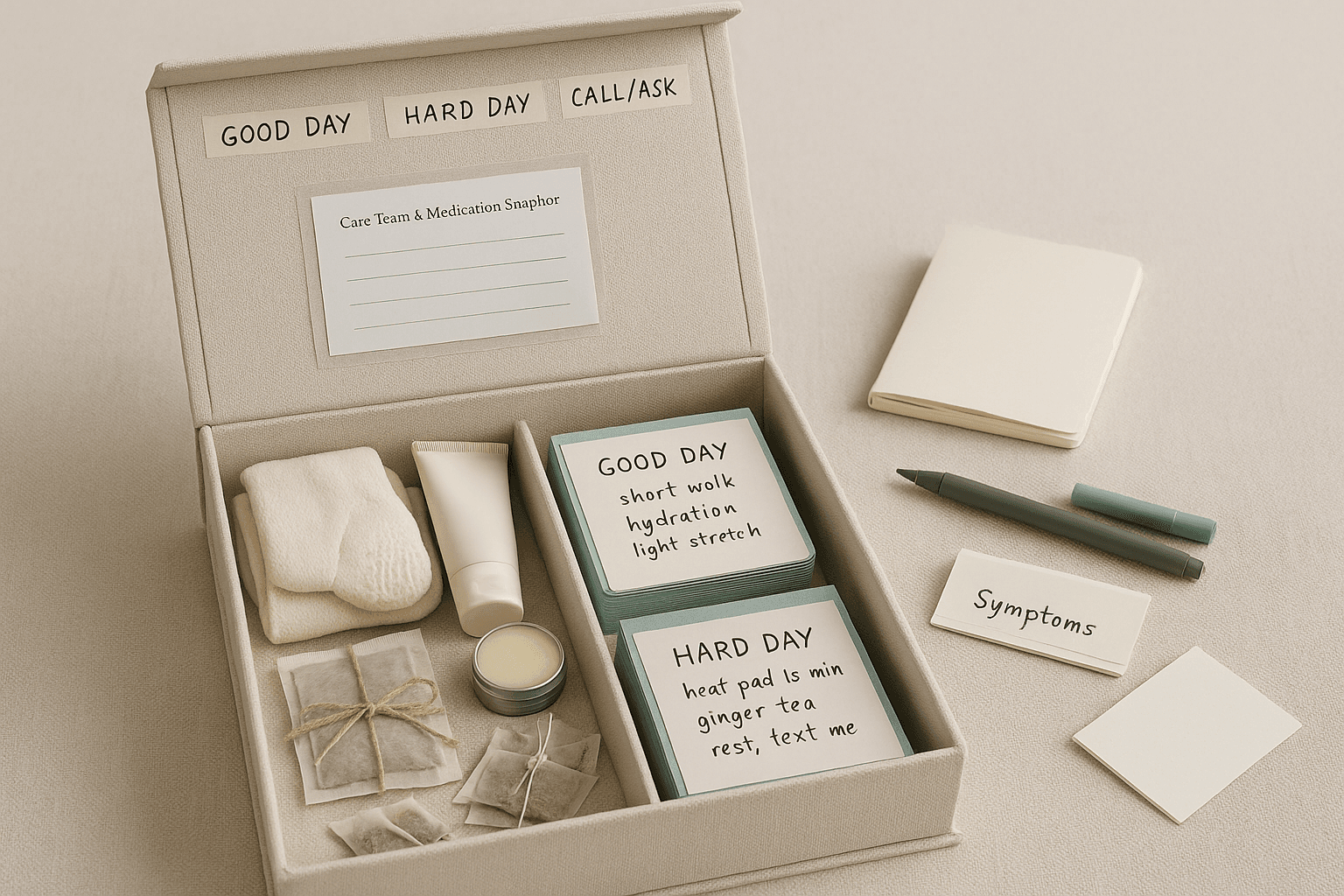
A lidded box with two zones of comfort items, a deck of twenty color-coded Good Day / Hard Day cards, and a two-page Care Team sheet. For someone you care about living with chronic illness, recovery, or a fresh diagnosis. An afternoon to assemble.
Materials
- A sturdy lidded box, shoebox-sized (about 13 × 8 in) — wood, fabric-covered, or a sleek storage tin
- A pack of 4 × 6 in index cards (the deck uses 20), a fine-tip pen, a black marker for the lid, and one green and one blue highlighter for color-coding
- A small notebook (A6) with the first six pages labeled, one heading per page — Symptoms / Triggers / Questions for Doctor / Med Changes / Wins / Support Preferences (the last one for them to fill in: what helps, what doesn't, foods that sit okay, how to check in)
- Two printed pages for the Care Team & Medication Snapshot (you'll make these in Step 4), an A2 envelope (4⅜ × 5¾ in) to keep them in, and a roll of masking tape for the envelope and the lid labels
- Comfort items, low-scent, chosen from what they like and what their care team allows: heating pad, non-slip socks, unscented hand cream, lip balm, herbal tea (ginger, peppermint, chamomile)
- Practical kit: 2–4 electrolyte packets, 2–3 shelf-stable snacks that fit their diet, a foldable phone stand, tissue paper to line the box
"No fixing. Just with you — and a few cards for the rest."
Instructions
- 01
Divide the box into two zones. Comfort on the left — heating pad, socks, hand cream, lip balm, tea, the tissue-lined nest. Track & Ask on the right — the notebook, the card deck, the Care Team sheet, the pen and highlighters. Two zones, not three; on a hard day, three is too many.
- 02
Write the twenty-card deck. Eight GOOD DAY cards (run the green highlighter along the top edge) and eight HARD DAY cards (blue edge). One action per card, written large. Ask them what already helps, and use that and their care team's advice, not your guesses. GOOD DAY: Take a ten-minute walk. GOOD DAY: Do one small task, then stop. HARD DAY: Feeling sick? Sip the drink that settles you. HARD DAY: Pain spike? Do what your care team said to do. HARD DAY: Something new or worse? Call your care team. Include one Point-Don't-Explain card for the foggiest days: Text me a number — 1 water, 2 tea, 3 soup, 4 nothing, just sit with me. The recipient replies one digit instead of forming a sentence. Add three cards specific to them, one action each: Put on [their comfort playlist]. Watch one episode of [the show they re-watch]. Read [the short prayer or line that helps them]. That makes twenty: eight GOOD DAY, eight HARD DAY, one number card, three of theirs.
- 03
Label the inside of the lid. Three headings on strips of masking tape: GOOD DAY · HARD DAY · CALL/ASK. Under each, three bullets in marker, large enough to read at arm's length: GOOD DAY — short walk, hydration, light stretch. HARD DAY — rest, water, pull a card. CALL/ASK — new symptom, med side effect, fever, pain change. The lid is the index; the cards are the play.
- 04
Make the Care Team & Medication Snapshot sheet, if they'd like one. Ask first. Page one, printed on ordinary letter paper, filled in with them (or left for them to fill) and copied from their current medication list, not from memory: current meds with dose and time, allergies, pharmacy, primary doctor with specialists and phone numbers, emergency contact. Two short sections at the bottom — What helps during flares and What makes it worse. Page two: six questions they'll actually need at the next appointment — side effects to watch for, who to call after hours, expected timeline, next test, what counts as urgent vs routine, medications that interact — with three blank lines under each, large enough to write in. Fold both pages into quarters, slip them into the A2 envelope, write Care Team & Medication Snapshot on the front and tape it inside the lid, below the headings. Under stress the mind goes blank; pre-written questions get asked. This is the page that gets handed to a new nurse, a covering doctor, or a worried sibling. Make it easy.
- 05
Close it with the note, not a kit slip. Tissue paper over the contents, the card script on top, lid down. When you hand it over, say one sentence — You don't have to read it all today. Leave.
What to write inside
For [their name] —
No fixing. Just with you.
Three promises so you don't have to wonder:
- I'll listen first. You don't have to perform being okay for me.
- On a hard day, pick a card or text "hard day." I'll offer two simple choices — call now, or sit with me later.
- The Care Team sheet stays current. When something changes, tell me and I'll update it.
— [your name]
Sign however you would — With love, In your corner, Thinking of you, or just your name.
Pro Tips
- Design for symptoms, not aspirations. Four rules layered into the build:
- Flare-up first. Every card should answer what do I do right now in one action — not a paragraph, not a flowchart. The good day takes care of itself.
- Low-scent everything. Unscented hand cream, mild herbal tea, fragrance-free lip balm. Chronic illness often comes with nausea or scent sensitivity; ask before adding anything floral, eucalyptus, or strongly herbal.
- Brain-fog math: bigger handwriting, fewer words. If their illness involves fatigue or cognitive symptoms (long Covid, MS, lupus, post-chemo, depression during a flare), use large block letters and one action per card. Density is the enemy.
- Easy to open, still sealed. Choose tear-notch packets and easy-open snacks, check the heat pack instructions, check the phone stand holds their phone. Leave food and drink sealed as it came. A flare-day brain can't fight packaging, so pick the easy kind at the shop.
- Keep the Care Team sheet alive. Set a recurring reminder on your own phone — quarterly — to ask if anything's changed. New medication, new specialist, new pharmacy. If they want the help, update the sheet together from their current list, reprint, swap it in. The freshness is the gift.
- Optional: add Comfort Coupons. Cut four more index cards in half for eight coupons and tuck them beside the deck: specific IOUs the recipient can hand back any time, no explanation owed. One pharmacy pickup. One evening: I handle dinner and cleanup. 90 minutes of quiet while I take the calls and errands. A ride to an appointment, and I take notes. A foot soak set up, ready when you are. The rule: redeemable, no guilt, no expiry. Specificity is the gift — I'll help more lands as nothing; I'll do a load of laundry and put it away lands as relief.
- Offer a pocket-tin version for the road. If they spend hours in waiting rooms or travel for appointments, build a second mini-tin (Altoids-style, ~3.7 × 2.3 in) — three to five HARD DAY cards on a small binder ring, ginger chews, two tea bags in a zip pouch, alcohol wipes, a folded Clinic Call Script prompt (Hi, I'm calling about… My symptoms are… My question is…), and one card that says Whatever this is, you're not carrying it alone. The box stays home; the tin goes in the bag.