DIY Idea
A Debt-Free Journey Binder — Receipts, Letters, the Final Statement
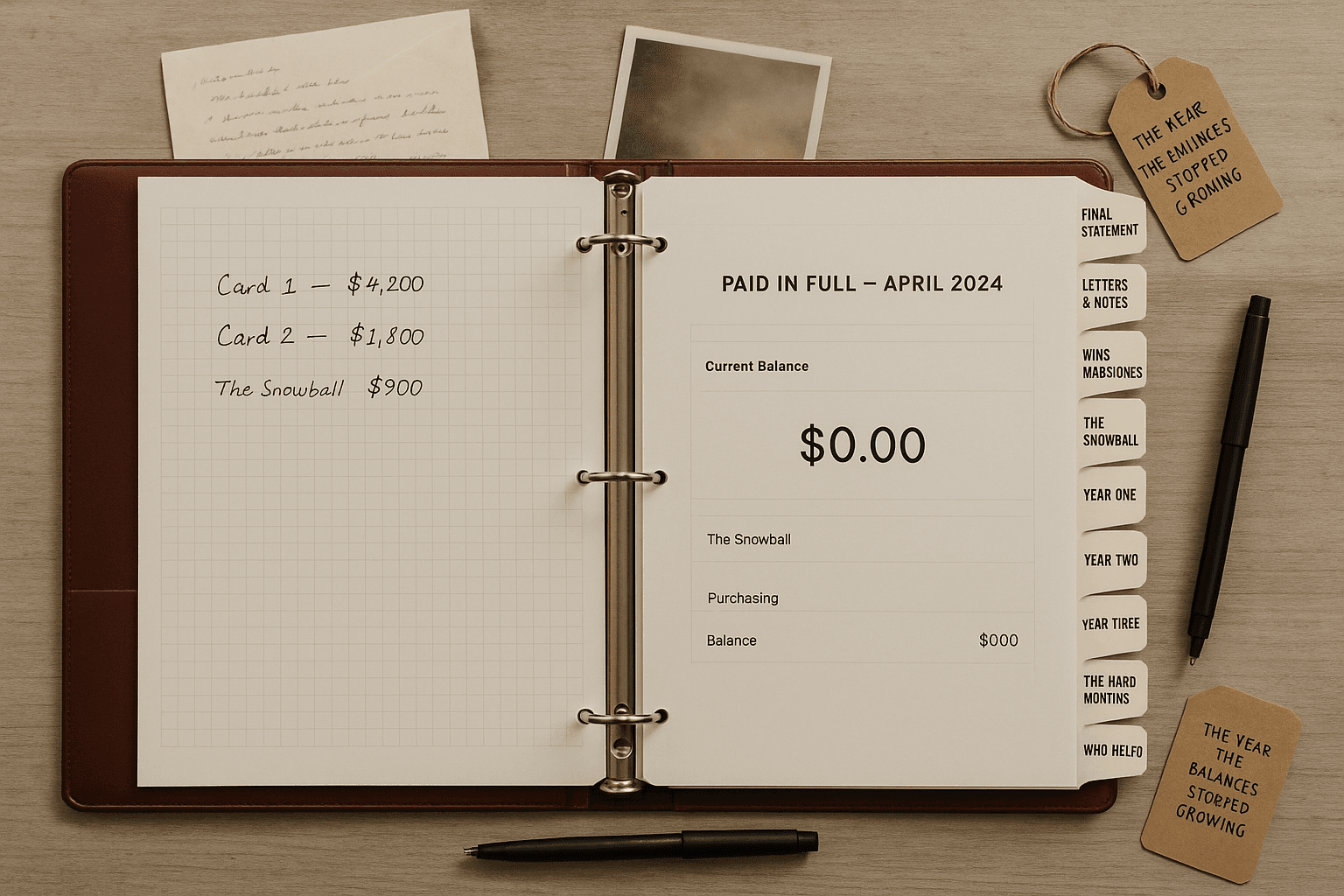
A 3-ring binder given a few months after the payoff: a tab for each stage of the journey, a folded letter in your handwriting, and a plain “Paid in full” cover page. The looking-back half of debt-free care, for someone who'd welcome a look back at those years, so ask them first. An afternoon to assemble once you have the papers, years to keep.
Materials
- The binder: one 1.5–2 in 3-ring binder in a calm neutral (oxblood, navy, or oat linen), tab dividers (nine, plus one per year of the payoff: twelve for three years), twenty sheet protectors, one pocket folder for the front
- The cover page: one plain sheet reading Paid in full — [month, year] for the front clear cover. The payoff letter or confirmation they choose to share goes inside behind tab 1, with account numbers covered by a marker or a plain label
- The receipts: copies of what they choose to share — the first month's snowball spreadsheet, an early budget written on graph paper, a lender letter — printed on a home printer or at a copy shop
- The letter: one folded A4 sheet of stationery, a fine-tip pen, and a 4 × 6 photo of you and them from somewhere in the payoff years
- The kraft tags: ten 2 × 3 in kraft milestone tags on a binder ring (for tab 3 — Wins & Milestones: five you write, five left blank), plus a small kraft caption tag for each paper they share (up to nineteen: your letter and photo take one of the twenty protectors) and a glue stick
The binder isn't the celebration. It's the proof someone saw how hard they worked.
Instructions
- 01
Make a plain cover page. One line, printed or in your hand: Paid in full — [month, year]. Slip it into the front clear cover. The proof goes inside, behind tab 1: the PAID IN FULL letter or payoff confirmation they choose to share, in a sheet protector, with account numbers and personal details covered first. (An account closed notice isn't the same thing; a closed account can still carry a balance.) No washi tape on the cover. The plainness is the point.
- 02
Label twelve tabs in this order. (1) The Final Statement, (2) Letters & Notes, (3) Wins & Milestones, (4) The Snowball Pages, (5) Year One, (6) Year Two, (7) Year Three, (8) The Hard Months, (9) Who Helped, (10) What Got Cut, (11) Photos, (12) After. Adjust the Year tabs to however many years the payoff actually took: nine fixed tabs plus one per year (twelve for three years). The Snowball Pages hold the payoff plan; Who Helped, the people who backed them; What Got Cut, what they went without; After, room for whatever comes next. A tab can stay thin until they add to it. The chronology IS the structure — don't collapse the years into one tab to save space.
- 03
Put the papers they shared behind the year tabs. Only what they've chosen to give you: the first snowball spreadsheet (printed and dated), an early budget scribbled on graph paper, a letter from a lender or credit counselor. Cover account numbers first. Each one in a sheet protector with a small kraft caption tag glued to the corner — your handwriting, one line: "April 2022 — the month the first balance hit zero." The captions are half the gift.
- 04
Write the letter and place it behind tab 2. One folded A4 page in your handwriting. Three beats: (a) one specific month you remember from those years, named with the year, (b) one real thing you saw them do or give up to get there, from what actually happened, not a guess about why the debt was there, (c) one line about what their steadiness proved about them. Tuck the 4 × 6 photo behind the letter. Don't write about the next chapter here — that's not what this binder is for. This binder is the looking-back half.
- 05
Pre-write the first five milestone tags. On the kraft tag ring for tab 3, write five in your hand before you give it: Use what really happened. For example: "First month with no minimum payments." "The first balance that hit zero." "The halfway mark." "The month you stopped counting." "The morning of the payoff." Leave five blank for them to add. The pre-written ones do the heavy lifting; the blanks invite them in.
What to write inside
[Their name],
This isn't a planner. It's a binder of the years.
The cover marks the day it was paid off. The letter and tags inside are in my handwriting because I saw how hard you worked — [two or three real things you remember from those years]. I wrote down what I saw.
The empty pages are yours. Add a receipt, a photo, a line — whenever you want. There's no schedule.
I'm proud of you. I have been for years.
— [your name]
Sign however you would — With love, Always, In your corner, or just your name.
Pro Tips
- Ask them before you start. Some people are glad to look back at those years; some would rather not. If they'd like it, ask what they kept and are happy to have in it: I want to build something to mark the years; would you send me whatever you'd like in it? They choose what goes in. Cover account numbers and personal details before anything goes into a sheet protector.
- Use their handwriting wherever you can. A photocopy of their original snowball list in their own writing is worth more than ten typed pages of yours. If they kept a budget notebook, ask if you can scan one page. Their handwriting from the hard months goes into sheet protectors verbatim.
- Don't add a Future Goals tab. The instinct is to extend the binder forward — next house, next savings, next goal. Resist. The binder is the journey half of debt-free care; the what's next half is its own gift on its own day. Mixing the two collapses both. (If they bring it up themselves, the After tab at the back is room enough.)
- Give it on an in-between date. Not the payoff anniversary itself — that day belongs to them. A quiet Sunday a few months later, when the rush of the payoff has faded and the years of work feel further away than they should. That's when the binder lands hardest.