DIY Idea
A Case-Study Binder for a Career Move — One Story, Marked Up
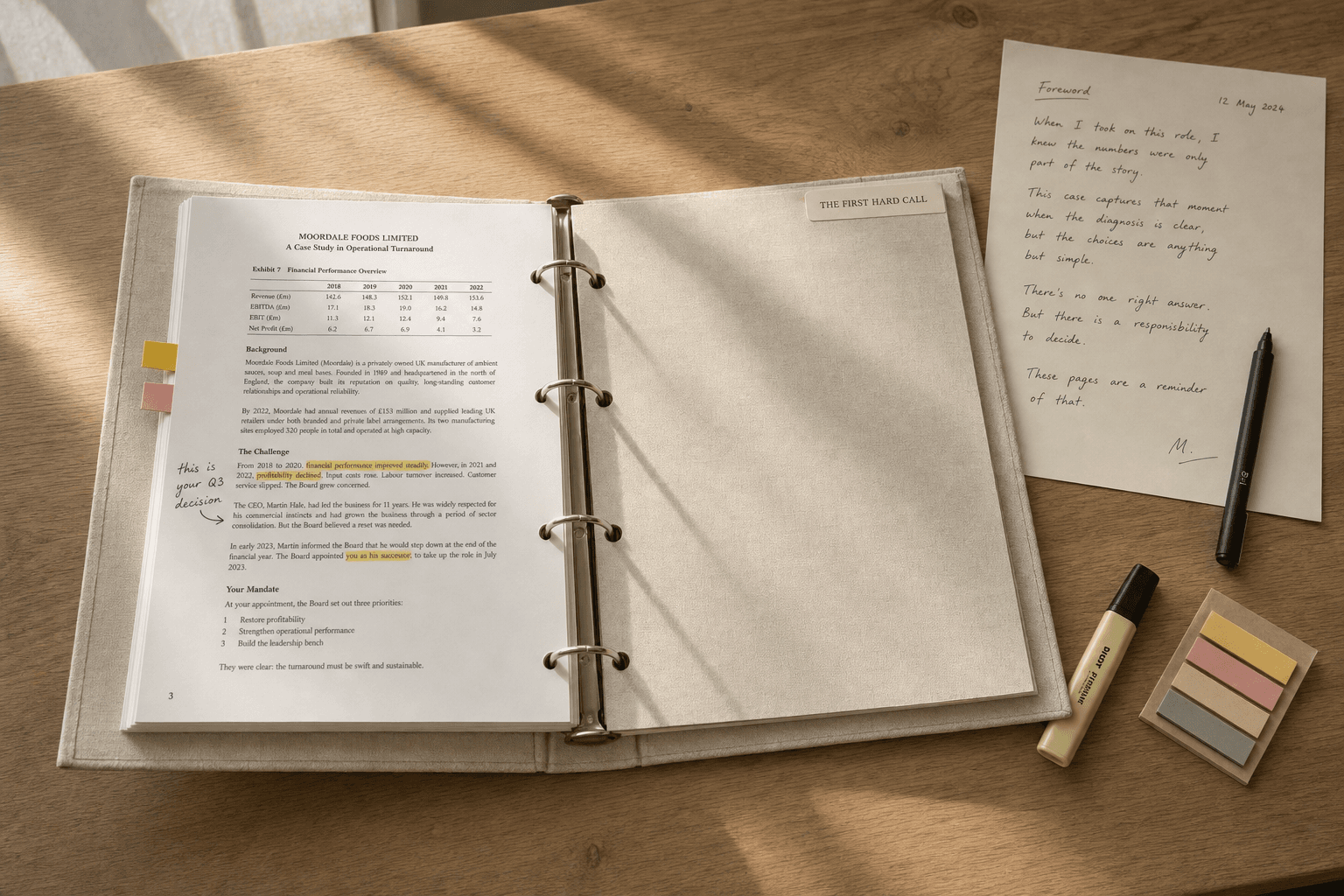
One case study — a founder, a turnaround, a hard pivot — printed, tabbed, and annotated in your hand for the person making their move. Two evenings to build.
Materials
- The case: one printed long-form story — a founder bio, a turnaround memoir, a HBR-style case (e.g., the Airbnb air-mattress era, Patagonia's pivot, or a peer's first 90 days in a new role)
- The binder: an A4 or letter-sized linen or leather binder, 1–1.5 in spine — the kind that opens flat on a desk
- The structure: eight to ten labeled tabs and 30–60 sheets of 28 lb paper
- The marks: a fine-tip black pen, one yellow highlighter, two colors of sticky tabs
- The foreword: one sheet of 32 lb cream paper for the opening letter
- The extras (optional): a quality pen for them, a small presentation box, a coffee-shop gift card
"The binder is a vote of confidence — in book form."
Instructions
- 01
Pick the one story. Not three, not a reading list — one. Match it to what's actually in front of them: the founder bio for someone starting their own thing, the turnaround memoir for someone inheriting a mess, the role-transition case for someone leveling up. Specific beats inspirational.
- 02
Print and tab it. Eight to ten sections is plenty: The Setup, The First Hard Call, What Almost Broke It, The Pivot, What They Did Differently, The Outcome, Applications for You, Your Notes. Skip Reflections and Worksheets. Don't double-tab the same beat.
- 03
Mark it up in your hand. Highlight the lines that made you think of them. In the margin, write why — "This is your Q3 decision" or "You said exactly this last Tuesday." Keep it conversational. Six to ten margin notes lands harder than fifty.
- 04
Write the foreword. One page. Three short paragraphs: why this case, why now, what I'm rooting for. Date it. Sign it. This is the part that makes it a gift instead of homework.
- 05
Add three blank worksheets at the back. Title them What's My Version of This?, Where I'm Stuck Right Now, and One Thing to Try This Month. Three prompts. No more. The blank pages are an invitation, not an assignment.
What to write inside
A Case Study for [their name]
I picked this one because of what you said about [the move / the doubt / what's keeping you up]. The story isn't a map. It's proof that the path through is messier than the case studies make it look — and that the people who came out the other side were the ones who kept choosing.
The tabs are the path. The margin notes are mine. The worksheets are yours.
— [your name]
Sign however you would — With love, Cheering you on, In your corner, or just your name.
Pro Tips
- One case, deeply known, beats a syllabus. The instinct is to add Lean Startup + Good to Great + four HBR articles. Resist. The gift is the depth of your engagement with one story, not the breadth of the reading list.
- Annotate from your relationship, not from the text. "Page 47: the founder froze for a week. You did this on the Henderson deal — and then you didn't." That's the gift. Generic "key insight!" margin notes belong on a Kindle, not in this binder.
- Match the binder to the person, not the topic. A founder who runs Notion-everything gets a sleek minimalist portfolio. A literature-loving exec gets cloth-bound linen. The artifact's register tells them you saw them, not the genre.
- Offer to walk it through with them — but don't make it conditional. The card can mention "happy to talk it through over coffee." The binder works whether they say yes or read it alone at midnight.