DIY Idea
A Deployment Letter Box — Thirty Envelopes for the Hard Days
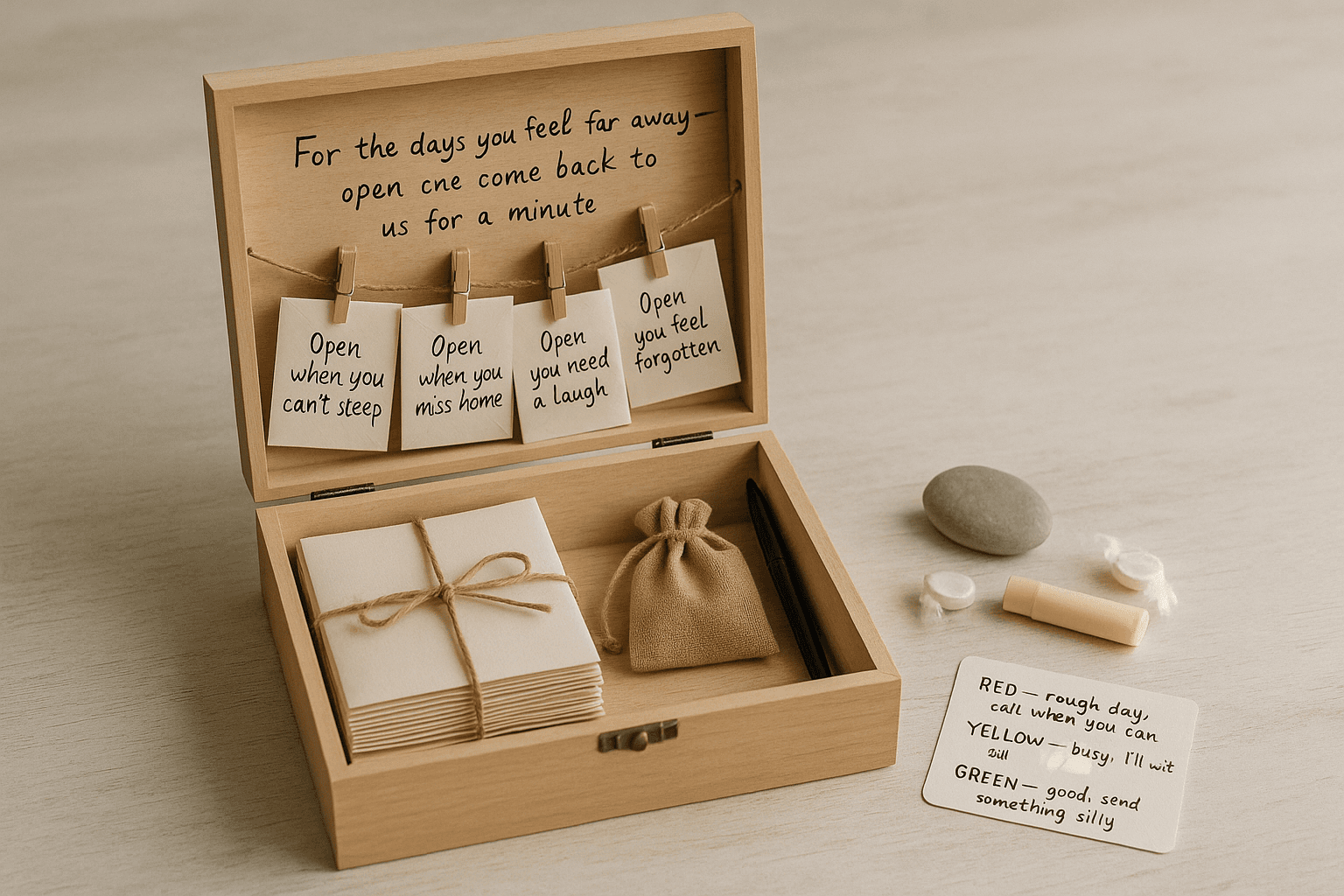
Thirty sealed envelopes for the moments deployment actually hits — can't sleep, miss home, before the briefing — with a laminated wallet card that holds a low-signal text code. For someone you care about who's deployed. A few evenings of writing, then about an hour to assemble.
Materials
- The box: a sturdy lidded keepsake box (wood or rigid cardboard, ~8×6×4 in) to hold the envelope stack
- The envelopes: thirty 3 × 4 in mini envelopes with cardstock inserts cut to fit (five of them are the no-signal notes in the tips)
- The wallet card: one clear self-adhesive laminating sheet and a piece of cardstock cut to 1⅞ × 3⅛ in
- The writing kit: fine-tip black pen, two colored pens, washi tape, mini stickers, a paint pen for the lid, clear packing tape, a glue stick, a few sheets of tissue paper, and one extra A2 envelope and a sheet of paper for the write-back letter in the tips
- The display: twine and two mini clothespins to clip envelopes inside the lid like a clothesline
- The comfort pouch: small zip bag holding a worry stone, lip balm, travel lotion, tea or coffee packets, individually-wrapped mints
- Optional: 5–10 wallet-size photos of you two, and 3–5 QR codes printed for voice or video messages
The envelope they don't open is doing the same work as the one they do.
Instructions
- 01
Plan the envelope set around real moments. Pick prompts that match deployment reality, not greeting-card moments. Examples: Open when you land, Open when you can't sleep, Open when you miss home, Open when mail is slow, Open after a hard day, Open before a briefing, Open when you feel proud but can't say it, Open when you're coming home. Mix emotional triggers with practical moments. Write the prompt on each envelope front in fine-tip black with a small icon.
- 02
Write the letters short and specific. For each envelope, write one focused message on a cardstock insert: a memory, a pep talk, a specific compliment, a mini-story. Aim for short-read notes (30–60 seconds) for most, with three or four longer ones for arrival week, mid-deployment slump, and the final stretch. Skip the everything happens for a reason register entirely. Seal each envelope with a sticker or washi strip.
- 03
Make the laminated wallet card with the low-signal code. Cut cardstock to 1⅞ × 3⅛ in, a little smaller than a bank card, so the laminate can seal about ⅛ in all round and the finished card is bank-card size (about 2⅛ × 3⅜ in). Front: a short message and a photo of you two or a simple graphic. Back: a low-signal text code you've agreed together, for when they can use it (RED = rough day, call when you can; YELLOW = busy, I'll wait; GREEN = good, send me something silly), your email or address, and one grounding script (breathe in 4, hold 4, out 6, repeat three times). Laminate, trim to about 2⅛ × 3⅜ in, keeping the sealed edge, and round the corners. Slide it into a card slot in their wallet to check it fits before packing. This card stays on them when nothing else can.
- 04
Build the countdown display inside the box. String twine across the inside of the lid like a mini clothesline. Clip the next two envelopes on it with mini clothespins (two 3-in envelopes fill the lid's width); stack the other twenty-eight in the base in two piles, numbered or grouped (Week 1, Week 2). On the inside lid above the line, write one quiet message: For the days you feel far away — open one and come back to us for a minute.
- 05
Pack it for travel and seal the kit. Lay the laminated wallet card on top of the envelopes, where they'll see it first. Check what their unit and the mail service allow, then add the comfort pouch on top of the piles. Heavier items go at the bottom; tissue paper fills empty space so envelopes don't slide. On the box lid in paint pen, write the title (Deployment Letter Box) and add one small symbol — a star, a heart, the coordinates of a meaningful place. Tape a top card with the rules: Open one a day, or open none. No order required. Re-open favorites.
What to write inside
For [their name], for the months ahead.
There are thirty envelopes in here. Each one is labeled for a moment — can't sleep, miss home, hard day, before the briefing, coming home. Open whatever matches. Open one a day, open none, open the same one twice — there are no rules.
The laminated wallet card stays on you. The back has our low-signal code, for when you can and when it's allowed: RED means rough day, call when you can. YELLOW means busy, I'll wait. GREEN means good, send me something silly. No word is fine too. I'll keep writing.
You don't have to be okay. I'm here.
— [your name]
Sign however you would — With love, Thinking of you, In your corner, One day closer, or just your name.
Pro Tips
- Make five of the thirty no-service backup notes, for low-connection environments. Label them For when there's no signal and put a grounding prompt on each: the 5-4-3-2-1 senses exercise, a breathing pattern, a single memory written out in detail. The kit still works when comms don't.
- Reinforce 3–4 high-use envelopes with clear packing tape on the seams. Open when you can't sleep and Open after a hard day get opened over and over — without reinforcement they tear.
- Skip lickable seals, glitter, scents, and confetti. Use tape or a glue stick. Many deployed environments have strict cleanliness rules, shared spaces, and zero tolerance for things that crumble in a uniform pocket.
- Add one extra, full-size envelope (A2, in the materials) addressed back to you, labeled Open when you want to write back. Inside, include a folded sheet with five easy prompts (best moment this week, one thing you're proud of, what you miss most). Replying feels doable when the prompts are already there.