DIY Idea
A New Chapter Binder — For Someone Leaving a Toxic Relationship
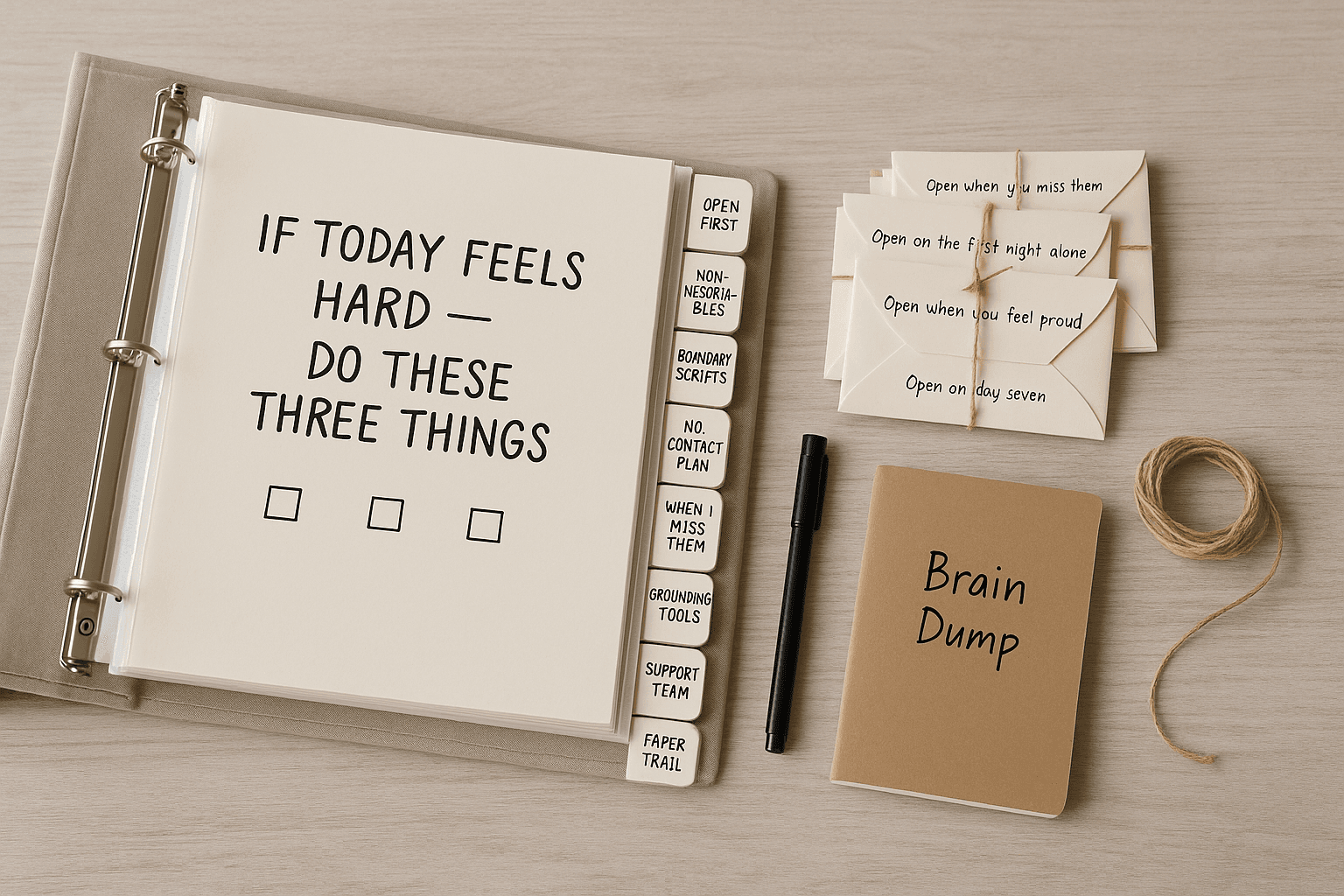
A 1.5-inch binder with ten labeled tabs — scripts they can copy, a no-contact protocol, an emergency "open first" page, and ten sealed letters from you for the hard nights. For someone close to you leaving a harmful relationship. An afternoon to assemble; a year of decisions, pre-made. Before you make it, ask them whether a binder like this is safe for them to have and use: a written plan or log can be found by someone checking their things or their phone. Make it only if they want it, and let their own safety plan decide what goes in.
Materials
- A sturdy 1.5-inch D-ring binder (linen or faux-leather, neutral color — this is going to live in a drawer, not on a shelf)
- Ten write-on tab dividers — the section titles are in Step 1
- Fifteen letter-size plastic sheet protectors (so scripts and worksheets can be marked with dry-erase and reused)
- A few sheets of cardstock for the Open First page, plus 25 sheets of three-hole-punched letter paper for worksheets and the Incident Log
- A pack of 10 small envelopes (A6 or similar) for the timed letters
- A 3-ring zip pouch — for the slim Brain Dump notebook, a dry-erase marker, a pen and red dot stickers
- One fine-tip black pen, one fine-tip red pen for the no-contact page, and a roll of washi tape for the tab edges
The binder isn't the gift. The decisions already made, sitting between dividers, are.
Instructions
- 01
Build the ten tabs. Label the dividers in this order — the order is load-bearing because it's the order of decisions when a hard moment hits: (1) Open First (2) Non-Negotiables (3) Boundary Scripts (4) No-Contact / Low-Contact Plan (5) When I Miss Them (6) Grounding Tools (7) Support Team (8) Paper Trail (9) Wins Tracker (10) Future Me. Edge each tab in a different strip of washi so they can find the right section without reading the words.
- 02
Write the Open First page — the only page they have to read on a bad night. On one sheet of cardstock, write the line If today feels hard, do these three things and three checkboxes: Drink water and eat something / Text [your name] or [a friend] / Read the When I Miss Them page. Close with one sentence: You don't have to solve everything today — just the next ten minutes. Slide it into the first sheet protector. This is the page that does the most work.
- 03
Write five to eight Non-Negotiables, then write seven Boundary Scripts in their voice. For Non-Negotiables, write short, declarative lines they can circle or rewrite: No yelling. No surprise visits. No checking my phone. My friendships are not negotiable. I get time to think before I reply. For Boundary Scripts, write seven copy-and-paste lines they can use under stress, if limiting contact is part of the plan they have chosen: I'm not available for this conversation. Please email. / I'm choosing space. If you keep messaging, I will block this number. / If you need to exchange items, we can do it through [friend's name]. Put a red dot beside the two or three you think they'll reach for most.
- 04
Build the No-Contact / Low-Contact Plan and the Paper Trail. The Plan is a one-page checklist: a circle-one line (I'm doing no-contact / low-contact), a blocking checklist (phone, WhatsApp, Instagram, email, shared apps), a logistics block (returning items, shared subscriptions, key exchange), and a safety line (If I feel unsafe, I will...) with two or three options. The Paper Trail is five blank dated pages titled Incident Log (date, time, what happened, what I did) — so if boundaries get violated, they have a record instead of a memory they'll later doubt. Leave the Incident Log and the Plan out if they still share a home or devices with that person, unless they ask for them: a written log can be found.
- 05
Write the When I Miss Them worksheet, the Grounding Tools page, and the Release Lines page. The worksheet has three prompts in their own boxes: What am I actually craving — comfort, familiarity, or validation? / What did it cost me last time? / What do I want next-week me to feel? The Grounding Tools page has three quick exercises: the 5-4-3-2-1 sensory scan, paced breathing (inhale 4, hold 2, exhale 6), and a put-the-phone-in-another-room, walk for two minutes plan. On a separate sheet titled Release Lines (when you're ready), write three open prompts with room to answer underneath: What I'm done carrying. / What I forgive myself for. / What I choose next. Mark it optional — this is the page they'll reach for on a steady week, not a bad night. It goes behind the Future Me tab. Then the three tabs that are left: Support Team is one page with blank lines for the names and numbers they choose, plus a local domestic-abuse helpline; Wins Tracker is one page of dated lines for small wins (blocked the number, slept through the night); Future Me holds the Release Lines sheet and one blank page headed Six months from now, I want…. Slip a slim notebook into the pouch and label the cover Brain Dump — don't text them, write it here.
- 06
Write ten timed letters and seal them. These are the back of the binder. Label ten envelopes with specific moments — Open on the first night alone. / Open when you miss them. / Open before the meeting with the lawyer. / Open when you feel guilty. / Open when you feel proud. / Open on day seven. / Open on day thirty. / Open if you almost broke no-contact. / Open after the first time you laughed again. / Open when you feel free. Put one short note in each — naming specific strengths you've seen in them, never relitigating the relationship. Slip the sealed envelopes into the last three sheet protectors at the back, three or four to a protector, labels facing out. Then put a sticky note on the front cover: Use only what serves you.
What to write inside
For [their name] —
This isn't here to push you anywhere. It's here so the next move is already on a page when you don't have it in you to invent one.
Page one is the only page you have to read on the worst nights. The scripts are copy-and-paste — use them, change them, ignore them, it's all yours. The envelopes at the back are for nights I can't get there fast enough; open whichever name fits.
Text "binder" anytime. I'll come, I'll call, or I'll stay quiet on the line — whichever you need. No questions, no asking how you really are, no advice unless you want it.
— [your name]
Sign however you would — With love, Yours, In your corner, or just your name.
Pro Tips
- The No-Contact / Low-Contact Script is the page they'll touch most. Write five copy-and-paste lines on the first page of Tab 4 — I'm not available for this conversation. Please email. / I'm choosing space. If you keep messaging, I will block this number. / I can't meet in person. We can exchange items through [friend's name]. / Do not call this number; if it's an emergency, contact [name]. / I am not discussing the relationship. Pre-loaded scripts let them respond from the part of their brain that's still working when the rest isn't. If their situation isn't fully safe yet — they're still in the home, or sharing space with the person they're leaving — ask them first whether a binder is safe to have at all, and leave out the Incident Log and the no-contact plan unless they want them. A plain cover and a neutral spine (Recipes, Notes) make it less noticeable, not safe. A domestic-abuse helpline can help them make a safety plan for their own situation, including where to keep things like this.
- Add a Relapse Plan, not a Relapse Lecture. One page behind Tab 4, titled If I break no-contact with three lines: who to text first (someone who won't shame me), what to block again, what to do in the next ten minutes that isn't more contact. Shame spirals are the second wave of leaving; a pre-written plan gives them a next step that isn't more shame.
- Build the Reality Check page for the gaslighting after-effect, behind Tab 5. A two-column sheet titled What happened vs What I was told it meant. Write three examples in their words to model the pattern, then leave the rest blank. When doubt creeps in months later, the page is there to anchor what they actually lived.
- Skip the sympathy-basket additions. No candles, no bath salts, no tissues, no chocolate, no photo collage of better times. This is a tool, not a comfort box — the register is useful gear for the next decision, not here's how to feel. The sympathy version makes the binder feel like an artifact of how-bad-it-got; the gear version makes it feel like an artifact of how-they're-getting-through.